What is retrosynthesis?
The mental model — working backward from a target to buyable starting materials.
Retrosynthesis is a way of planning a synthesis by working backward from the target molecule to materials you can buy. Instead of asking "what can I make from these reagents?" you ask "what combination of simpler molecules could I combine to make this?" — then ask that again for each of those simpler molecules, and so on, until every leaf is something commercially available.
The mental model
Think of a route as a tree:
- The root is your target molecule.
- Each branch point is a reaction step: the node above is the product, the nodes below are the reactants.
- The leaves are starting materials — ideally commercially available.
Reading the tree from root down gives you the retrosynthesis (how to disconnect). Reading it from leaves up gives you the actual synthesis (how to make the target in the lab).
Why it's called "retro"
In forward synthesis notation, reactions flow left-to-right with an
arrow: A + B → C. In retrosynthesis, the arrow reverses and gains a
second line — you write C ⇒ A + B to say "C could be made from A and
B." That's a disconnection.
The goal isn't just to find any disconnection. It's to find the one that leaves you with simpler pieces you can either buy or synthesize yourself. Good retrosynthetic thinking recognizes which bonds are "easy" to disconnect (amide bonds, C–C bonds with clear reagent precedent) and which ones aren't.
What the model does
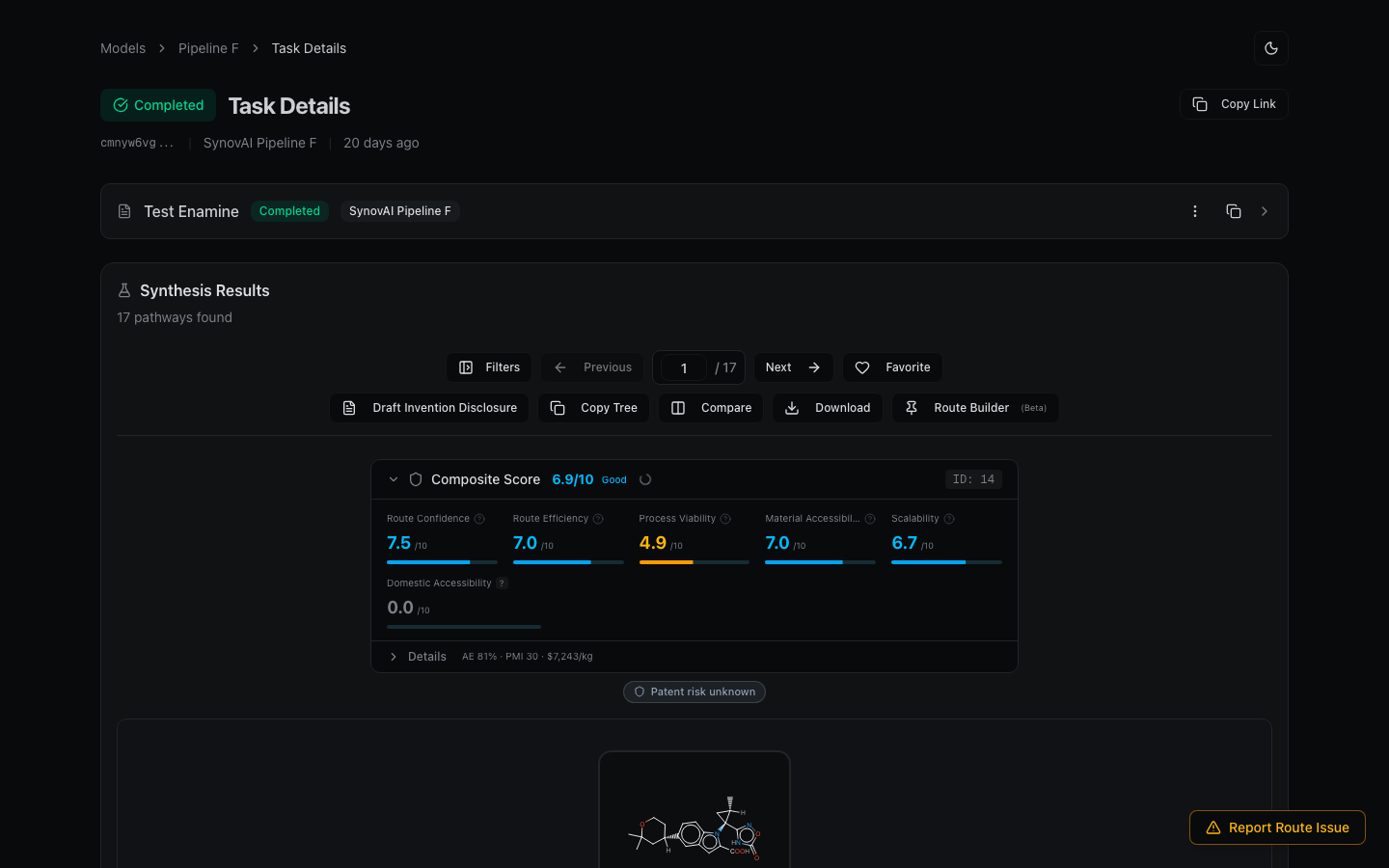
SynovAI's retrosynthesis model was trained on millions of published reactions. Given your target, it proposes transformations that resemble reactions the model has seen before. The precedent level controls how strict that resemblance has to be. The feasibility score tells you how much the model trusts each resulting route.
When retrosynthesis isn't the right tool
Retrosynthesis doesn't tell you:
- The experimental conditions (temperatures, solvents, workup) — for that, use reference entries.
- Whether the route is economically viable at scale — for that, see feasibility score and green chemistry metrics.
- Whether your specific substrate will behave like the training data examples — the chemist's judgment is still required.
It gives you candidate routes, ranked and annotated. The decision about which to run stays with you.