Updated May 5, 2026
Route evaluation and scale-up feasibility
Process chemist: rank routes by scalability and swap lab-scale-only steps before scale-up.
When transitioning a route from medicinal-chemistry scale to process scale, lab-scale moves (chromatography, expensive catalysts, low temperatures) become bottlenecks. This tutorial uses the platform's scalability scoring and reference data to identify the most manufacturing-friendly path.
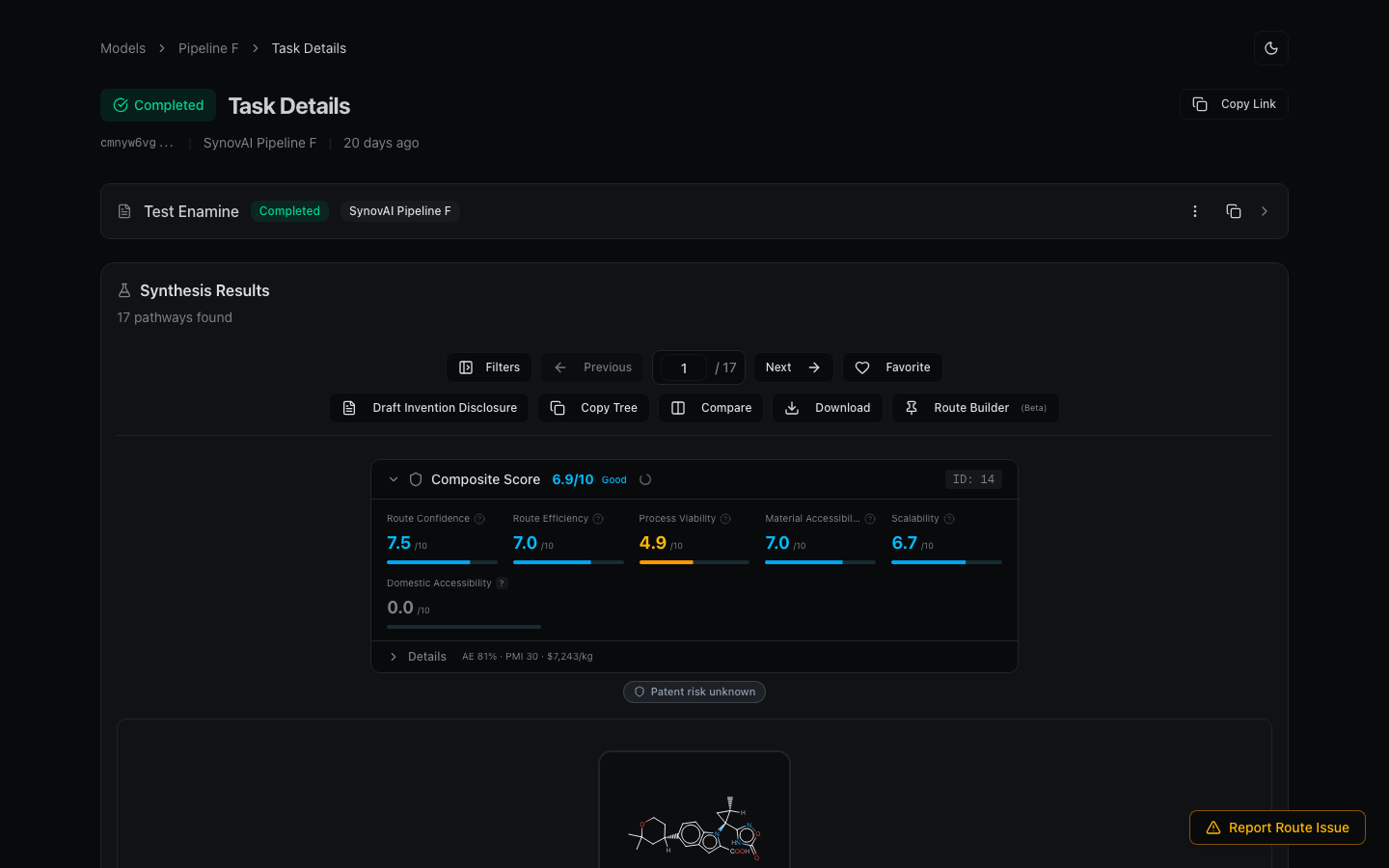
Steps
- Open a finished retrosynthesis result for the target.
- Apply the Process scoring profile (or the Lowest cost sort). This re-ranks routes by their scalability and cost dimensions rather than novelty or confidence.
- For the top-ranked routes, open each step's reference entries.
Read the published procedures for:
- Reaction temperature (process favors mild, ambient or near-ambient).
- Solvent (process favors common, recyclable: EtOAc, IPA, water, toluene).
- Workup (process avoids column chromatography; aqueous extractions and crystallizations are preferred).
- Catalysts (process favors common, recoverable, non-precious).
- Flag any steps using high-temperature, exotic-solvent, or chromatography-only procedures. These are scale-up risk points.
- Use Route Builder to swap any risky steps with equivalents pinned from other routes.
- Export the chosen route as a
lab bundle. The
procedure.mdandreagents.csvgive a CRO or your process group a complete starting point.
What you walk away with
A route candidate selected for scalability rather than discovery elegance, with the lab-scale bottlenecks already swapped or flagged.