Cost, safety, and green chemistry optimization
Educator: full route-evaluation exercise covering cost, safety, and environmental trade-offs.
A practical synthesis-design exercise that pushes students past "draw the mechanism" into "is this even a sensible thing to make at scale?" This tutorial structures a full route-evaluation problem across cost, safety, and environmental impact.
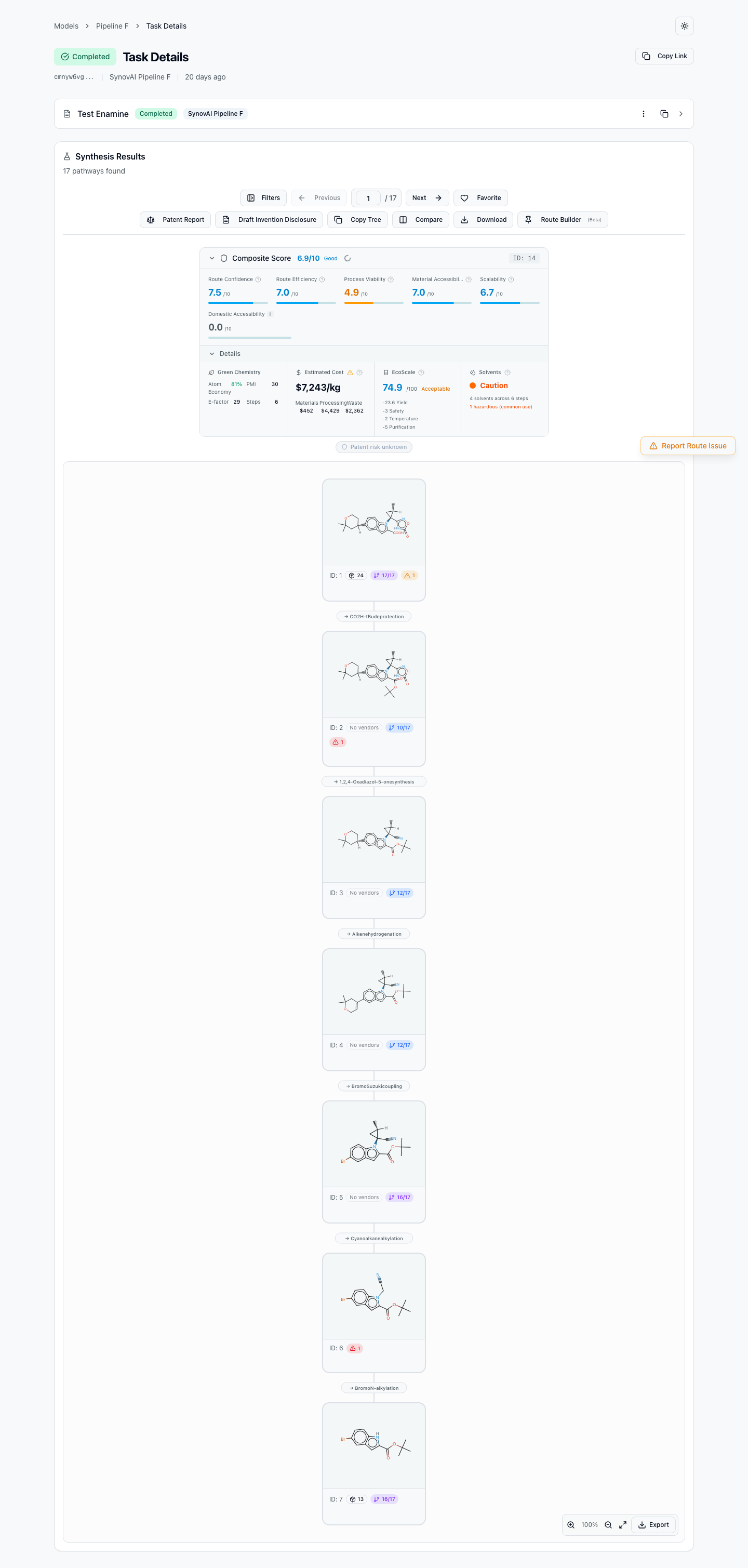
The exercise
-
Assign a target and ask each student to submit it through the retrosynthesis form.
-
Each student picks two routes: the highest-confidence route and a less-confident alternative. They favorite both.
-
For each route, the student fills in three rubrics:
Cost
- Sum the per-step starting-material prices from the vendor data for each molecule.
- Note step count: longer routes compound yield losses and labor cost.
- Estimate total cost-of-goods per gram of target produced.
Safety
- Walk each step's reference entries for hazardous reagents, solvents, or conditions.
- Look at the hazard flags automatically surfaced on the route.
- Identify which transformation is the most dangerous to run, and why.
Green chemistry
- Open the green chemistry metrics panel for the route.
- Note PMI, atom economy, E-factor, and EcoScale per step.
- Identify the worst-offender step and what could be done about it (the reagent swap suggestions often help).
-
Students present which route they'd run and defend the choice. The synthesis they want isn't always the cheapest; isn't always the safest; isn't always the greenest. Trade-offs are the lesson.
Why this works
Students leave with a working sense of the multi-axis trade-off space that real process chemists navigate daily. Far more transferable than a clean textbook synthesis problem.