Understanding your results
Interpret scores, badges, and hover cards on a finished result.
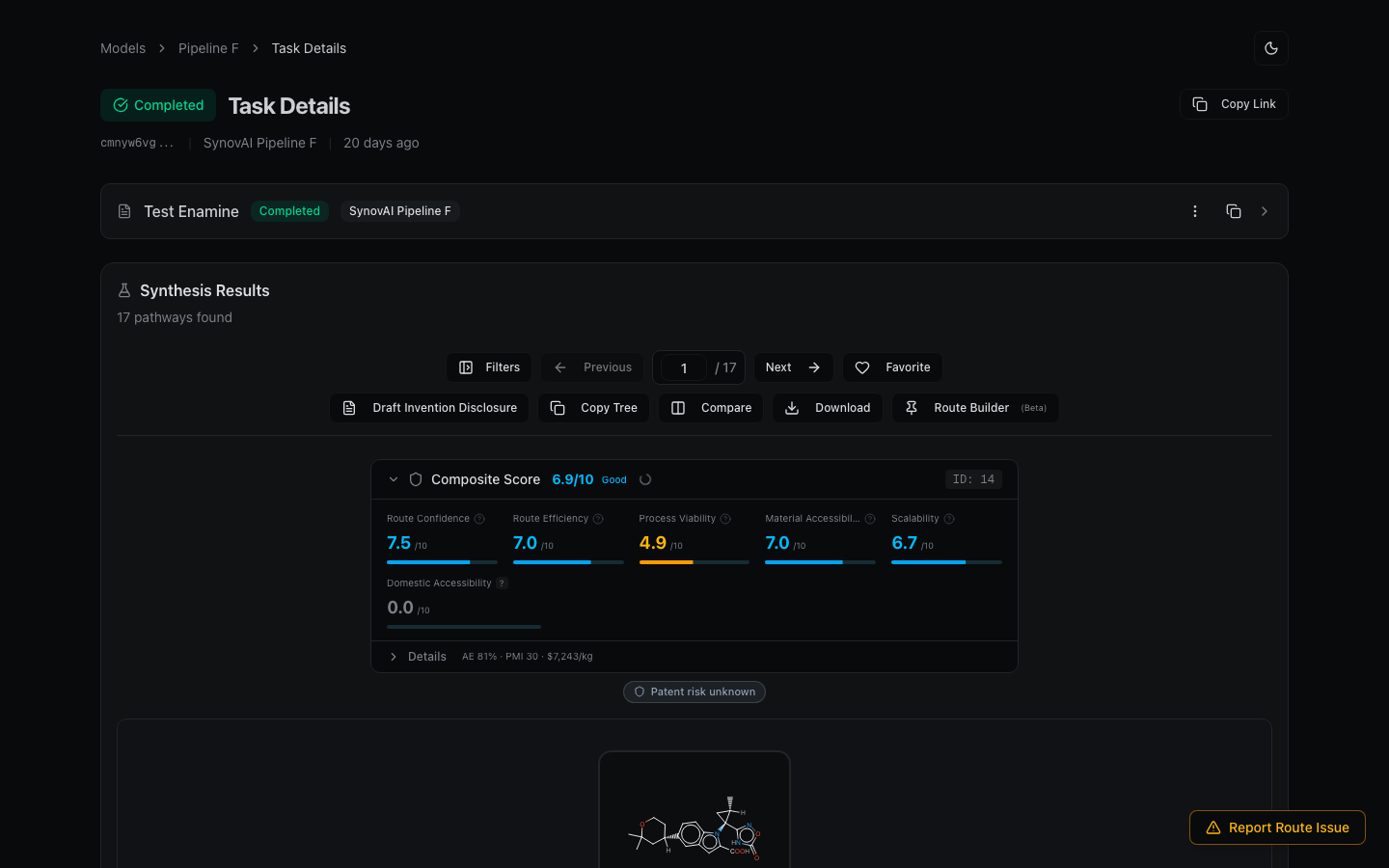
After a job completes, click Details to open the result viewer. Each result shows one or more retrosynthesis routes as tree diagrams. This tutorial walks through the parts of that view so you know what you're looking at.
The route tree
The target molecule sits at the top. Reactants branch downward, step by step, until you reach commercially available starting materials at the leaves. Every node is a real molecule — hover any node to see its structure, reaction type, estimated yield, hazard flags, and vendor availability.
Scores and badges
Each route surfaces several signals at once:
- Feasibility Score (0–10) combines five independently computed dimensions — Route Confidence, Scalability, Material Accessibility, Route Efficiency, and Process Viability — into a single sortable number.
- Details panel (click to expand) shows green chemistry metrics (atom economy, PMI, E-factor), estimated COGS, EcoScale, and solvent sustainability ratings.
- Vendor badges (package icon + count) mark molecules commercially available from PubChem-tracked suppliers.
- Convergence badges (purple / blue /
sky) show how many routes share an intermediate — e.g.,
17/17means every route goes through this molecule. - Hazard badges (yellow or red) flag steps with carcinogens, reproductive toxins, explosive reagents, or other safety concerns.
Hover cards
Hover over any molecule node to open its hover card. From there you can see the reaction type, estimated yield, reagents, solvents, reagent-swap suggestions, hazard warnings, GHS safety data, patent references, and the full vendor list with catalog IDs.
Browsing and filtering
Use the navigation arrows to browse through multiple routes. Open the Filters sidebar to sort by feasibility, confidence, scalability, cost, atom economy, or process viability. Apply a scoring profile or filter out reaction types you can't run in your lab.
What to read next
- Working with route results — the full nine-step analysis workflow.
- Feasibility score — a deep dive on the five dimensions.
- Scoring profiles — rank routes by weighted criteria you care about.